
May 22 serves as the annual International Day for Biological Diversity. Its 2026 theme, "Guard All Living Creatures, Nurture Shared Prosperity for All Species", calls on the public to defend biodiversity starting with the natural spaces around us.
Birds serve as a litmus test for local biodiversity. Highly sensitive to environmental shifts, the rise and fall of their populations act as an intuitive gauge measuring the stability of regional ecological structures, as well as the cleanliness of air and water bodies.
Then how many bird species can be found in Shanghai?
A search conducted by The Paper on eBird, a global bird observation platform run by the Cornell Lab of Ornithology, shows over 500 bird species recorded in Shanghai. This figure surpasses New York's 364 species, London's 318, Paris's 193 and Tokyo's 403.
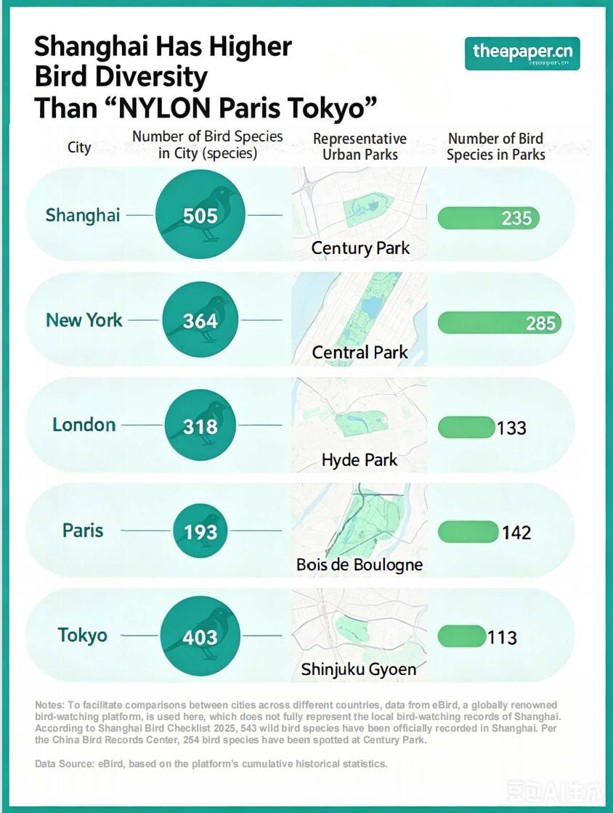
Since Chinese birdwatchers prefer using the China Bird Watching Record Center instead, the tally listed on eBird likely understates Shanghai's actual number of bird species.
Statistics from the Bird Recording Committee of the Shanghai Wild Bird Society reveal that documented wild bird species in Shanghai had increased from 475 in 2016 to 543 by 2025, accounting for 35.2% of all bird species nationwide. Shanghai thus ranks among the world's top megacities in avian diversity.

What accounts for Shanghai's remarkably rich bird life?
Lying at the estuary of the Yangtze River, Shanghai sits on a critical bottleneck along the East Asian-Australasian Flyway (EAAF), one of the planet's most vital migratory bird routes. After gruelling transoceanic journeys, weary migratory birds regard Shanghai's extensive coastal mudflats and scattered green spaces as vital "service stations" along their voyage.
Benefiting from a subtropical monsoon climate and abundant wetland resources, Shanghai stands among the world's metropolises with the highest proportion of wetland coverage. The city currently boasts 439,800 hectares of wetlands encompassing offshore coastal wetlands, rivers, lakes, marshes and other wetland types.
In contrast, urban agglomerations around North America's Great Lakes are located deep inland, while other world-class city clusters in Britain, France and Japan sit at higher latitudes.
Yet a prime geographic setting alone is no guarantee of rich bird-life. Shanghai's vast green landscapes are built on decades of persistent urban ecological restoration.
In Shanghai, birdwatching is accessible at community parks within walking distance of residents' homes.
In August 2025, the Shanghai Greenery and Public Sanitation Bureau announced the fulfilment of its goal to build a "City of a Thousand Parks". Shanghai now hosts 1,013 parks of all types: 522 urban parks, 371 pocket parks, 119 leisure forest parks and one themed park.
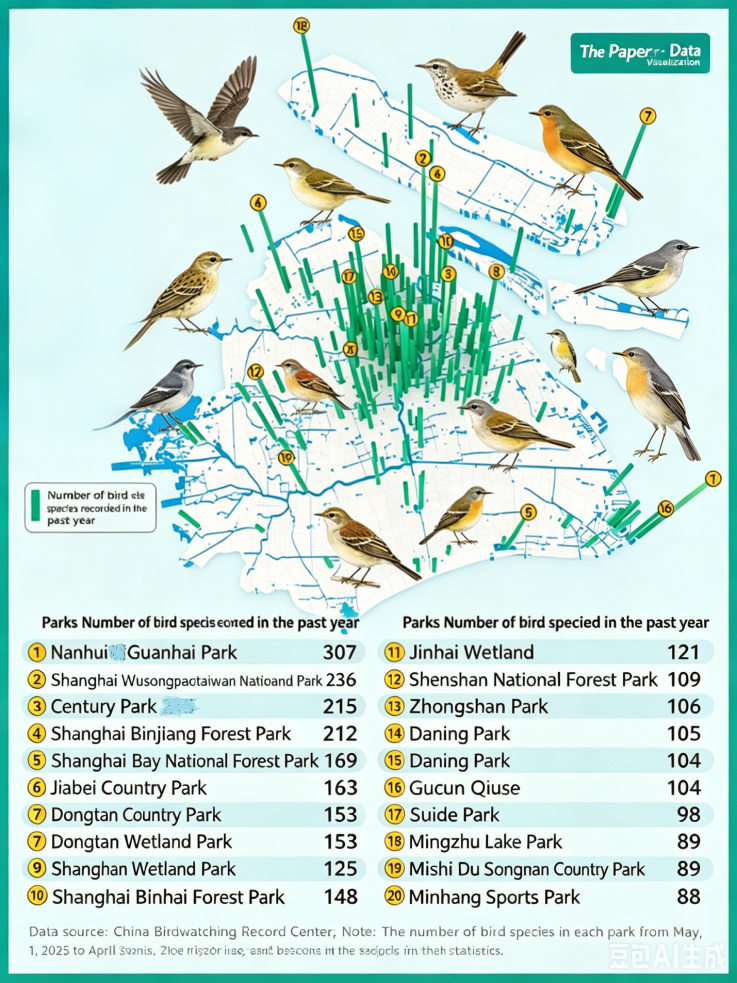
Many of these green spaces have become home to wild birds. Century Park, the largest urban park in central Shanghai, recorded 215 bird species over the past year and ranks as one of birdwatchers' favourite spots.
The origins of Century Park date back to 1993. Pursuing the national Garden City accreditation, Shanghai shifted its greening strategy from mandatory standards to scientifically rational development. Construction of this major ecological urban park within the Inner Ring Road kicked off in 1994.
Starting in 2000, Shanghai rolled out successive three-year environmental protection action plans. Following its successful bid to host the 2010 World Expo in 2002, the city accelerated its eco-city development. A string of parks opened to the public in sequence, including Minhang Sports Park, Shanghai Binjiang Forest Park and Shanghai Wusong Paotaiwan National Wetland Park. Years of careful conservation have turned these sites into thriving habitats for urban birds.
The Paper analysed Shanghai's birdwatching data from the China Bird Watching Record Center spanning May 2025 to April 2026. Among 38,000 observation logs covering 594,000 individual birds, nearly 250,000 sightings took place within city parks.
These birds are not confined to remote mountain forests. Their flight can be spotted in residential compounds, school campuses and especially neighbourhood parks close to home.
What Are Shanghai's Most Common Birds?
Many people would immediately name sparrows, yet records from the China Bird Watching Record Center show that spotted doves, blackbirds and light-vented bulbuls are encountered far more frequently year-round. Birdwatchers affectionately dub these four species the "Four Great Resident Birds" of Shanghai.
Beyond these widespread species, birders can even spot birds of prey in downtown Shanghai. At Daning Park in Jing'an District, crested goshawks have returned each spring for years to build nests and breed.
As birds of prey, crested goshawks normally inhabit mountain forests, woodland edges, bamboo groves and small thickets, occasionally venturing onto lowland plains and near villages. They mainly feed on frogs, rodents and smaller birds, and their presence signals a sound local ecosystem.
With a little attention, visitors can spot red-whiskered bulbuls at downtown Zhongshan Park and goldcrests at Century Park, alongside many other charming birds.
These fluttering creatures are not only nature's most vivid messengers but also sensitive indicators tracking ecological changes. Their thriving populations silently tell the story of this land's vibrant, balanced landscape where mountains, rivers and urban greenery coexist harmoniously.
Today, Shanghai continues speeding up the development of an ecological framework defined by "cities nested within parks, interconnected forest corridors, and interwoven blue waterways and green spaces". Parks are not only ideal spaces for residents to relax, but also the finest testament to a city's biodiversity.
This is not an official translation. Please refer to the original source.
(Reprinted from The Paper 07:30 May 22, 2026 Liangxian Chen and Yasai Wang, Reporters for The Paper)
 Home
Home About
About